
Government
Fire Operations
Fire Inspector - Cpt. Patrick Strausbuagh
The on-duty Code Official can be reached at 513.678.2292 (mobile) or 513.701.6989 x1580.
All construction inspections must be scheduled 24 hours in advance with our Department and the Warren County Building Department 513.925.1290. In addition to construction inspections the Deputy Code Officials conduct annual inspection of target hazard businesses of the Township.
All full-time employees of the Department are certified as Fire Safety Inspectors and conduct annual inspections in all of the Townships commercial and educational facilities.
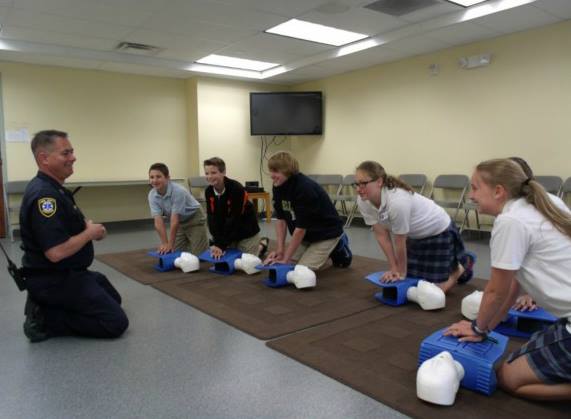
Public Safety Classes
CPR & First Aid Class
Learn the skills needed to possibly save a life. CPR classes are scheduled four times a year; once each quarter. Preregistration is required as class sizes are limited. Registration will begin the month prior to the class offered. Registration is done online through DeerfieldRec.com.
Fire Extinguisher Class
These classes are offered on an as needed basis depending on class size. For questions and scheduling please contact Andy Burwinkel at aburw@deerfieldtwp.com.
First Aid
These classes are offered on an as needed basis depending on class size. For questions and scheduling please contact Andy Burwinkel at aburw@deerfieldtwp.com.
Did you know?
Fire Prevention Week starts the first Sunday in October commemorating the great Chicago fire. Each year there is a new theme emphasizing different fire safety practices.

Chris Eisele, Fire Chief
Contact Information
- Phone: 513.701.6962
- Email: reise@deerfieldtwp.com
Experience
Chief Eisele began his fire service career in 1989 with the Miami Township Fire Department in Hamilton County. Chief Eisele was hired as Career Firefighter with the City of Forest Park in 1999. He was promoted to Lieutenant in 2002 and Captain in 2003. While at Forest Park, Chief Eisele began serving the citizens of Deerfield Township in December of 2000 as part-time Firefighter/Paramedic. Chief Eisele was promoted to the position of Career Battalion Chief with Deerfield in 2005 and was named Fire Chief in September 2008.
Chief Eisele graduated from Anna Marie College with a Masters of Public Administration in 2013 (Summa Cum Laude). Chief Eisele also holds a Bachelors Degree with honors in Fire Schiece from the University of Cincinnati and an Associate Degree in Fire Service Leadership from Cincinnati State Technical College where he graduated Magna Cum Laude.
Chief Eisele currently also serves as a adjunct Professor at the University of Cincinnati.
IF AN EMERGENCY DIAL 911
How Do I?
Prepare for a Fire Emergency
In less than 30 seconds, a small flame can get completely out of control and turn into a major fire. It only takes minutes for a house to fill with thick black smoke and become engulfed in flames. By preparing for a fire emergency, you can greatly reduce your chances of becoming a fire casualty.
- Install smoke alarms on every level of your home, including the basement. For extra safety, install smoke alarms both inside and outside sleeping areas.
- Test your smoke alarms once a month and change the batteries at least once a year.
- Replace smoke alarms every 8-10 years or as the manufacturer guidelines recommend.
- Plan your escape from fire. The best plans have two ways to get out of each room.
- Practice fire escape plans several times a year. Practice feeling your way out of the house in the dark or with your eyes closed.
- Purchase only collapsible escape ladders evaluated by a nationally recognized laboratory such as Underwriters Laboratory (UL).
- Check that windows are not stuck, screens can be taken out quickly, and that security bars can be properly opened.
- Make sure everyone in your family understands and practices how to properly operate and open locked or barred doors and windows.
- Consider installing residential fire sprinklers in your home.
Contact your local fire department on a non-emergency phone number if you need help or have questions about fire safety in your home.
Information provided by United States Fire Administration

Safety Town
Safety Town is an exciting interactive day camp for children ages 4 – 6 years old. This one week experience gives children the confidence and knowledge they need to be safe at home and during the beginning of their first years in school. Each day introduces a new theme while building on skills through creative hands on learning. Our trained counselors help solidify these lessons by making safety fun and meaningful.
Community Offerings
Station Tour
Visit any one of our 4 stations.
Our stations are open to the public at all times for a tour or you may schedule a tour for a group. All events and questions can be directed to Lt. Burwinkel by phone at 513.459.0875, leave a voice mail at 513.701.6989 x1304 or by email.
Car Seat Inspection
Is your car seat installed properly? Have one of our certified technicians inspect yours today. Car seat inspections are available throughout the week and on Saturdays by appointment. For scheduling and questions contact our Car Seat Hotline at 513.701.6989 x1332. Leave a voice mail and a Technician will contact you within twenty-four hours.
Home Inspection
Home Inspections are a requirement for all adoptions and foster care homes in Warren County. You may also choose to have you home inspected for your own personal reasons. All inspections are provided at no cost to Deerfield Township residents. To schedule a home inspection phone 513-678-2292.
Open Burning Guidelines
Information below is provided by the Ohio EPA:
Full-Time Firefighter / Paramedic
Deerfield Township Fire Rescue (DTFR) is hiring firefighter/paramedics on an ongoing basis until the roster is filled. Join our crew of more than 60 dedicated professionals in safeguarding our community. The role of firefighter/paramedic involves several diverse duties including fire suppression, EMS, rescue operations, and public relations. DTFR provides top-notch training and focuses on the professional development of each employee.
Utilizing four fire stations, DTFR serves more than 40,000 residents spanning 16 square miles. The department is operated under the direction of the Fire Chief along with his command staff comprised of four Deputy Fire Chiefs who direct the daily operations of each shift. Each fire station is managed by a Captain and two Lieutenants, with a maximum staffing level of 20 per day. The organization responds to around 5,000 emergencies per year.
Submit an application, resume, and cover letter to HR Specialist Alicia Hamann at ahamann@deerfieldtwp.com. Lateral entry options for applicants with three years of full-time firefighter/paramedic experience are available.
Hiring Process:
- Submit your application, resume, and cover letter.
- Submit a valid Firefighter Mile Test or a valid CPAT Test – not required for lateral entry applicants.
- Complete EMS Patient Care Simulator Evaluation -- not required for lateral entry applicants.
- Complete Panel Interview.
- Complete Command Staff Interview.
- Pass Post-Offer Psychological Evaluation and Ohio Police and Fire Pension Physical Exam.
2025 Salary and Benefits:
- $79,847.04 Annually.
- Optional $10,812.88 available through contractual overtime hours.
- Medical, Dental, and Vision Insurance.
- Three Week Kelly Day, 48 Hour Work Week.
- 96 Hours of Holiday Time Supplemental to Allotted Vacation Hours
- Vacation Time up to 240 hours under the CBC
- 12 Hours of Sick Time Accrual per Month.
- Outside Training and College Tuition Payment
- Unrestricted Shift Trades
Minimum Qualifications:
- Valid Driver’s License
- Ohio Firefighter Level 2 Certification
- Ohio Paramedic Certification
- Ohio Fire Safety Inspector Certification within 12 months
- Hazardous Materials Technician Training within 12 months
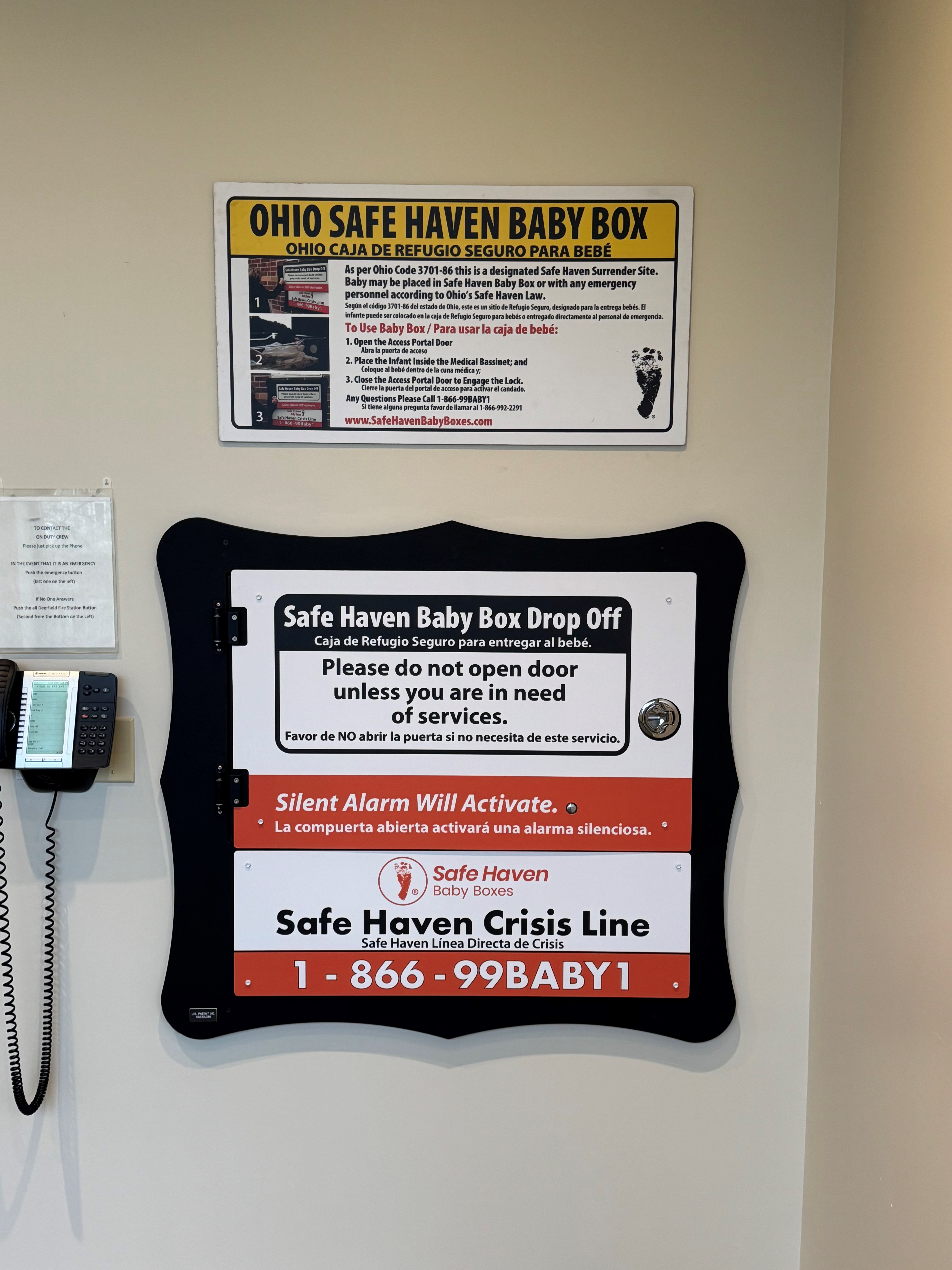
Ohio Safe Haven
Deerfield Township is proud to offer a Safe Haven Baby Box at Station 57 and Station 58, located at:
3435 W US Rt 22, Loveland, OH 45140 (ST57)
2095 Kings Mills Rd, Mason, OH 45040 (ST58)
This box provides a compassionate and secure option for mothers in crisis who are unable to care for their newborns. Designed with innovative safety features and installed on the exterior walls of fire stations and hospitals, each box ensures the safe and anonymous surrender of infants.
How It Works:
- The exterior door locks automatically when a newborn is placed inside.
- An interior door allows medical personnel to promptly and securely retrieve the baby, ensuring immediate care and protection.
Why It Matters:
- The Safe Haven Baby Box at Station 57.
- As of October 2025, there have been 69 infants surrendered.
Safe Haven Crisis Line:
1-866-99BABY1
Additional Resources:
Programs & Classes
Car Seat Inspections
Smoke Detector Battery Changes
CPR & First Aid Courses
Fire Extinguisher Training
Station Tours
Community Events
Fire Stations
Station 56
- Engine 56
- Medic 56
Station 57
- Ladder 57
- Rescue 57
- Medic 57
- Battalion 56
- Boat 57
Station 58
- Engine 58
- Medic 58
- ATV 58
Station 59
- Engine 59
- Medic 59
Fire Safety Inspections
Deerfield Township Fire Rescue is committed to keeping our community’s businesses safe and compliant with fire safety standards. Each year, our fire prevention staff conduct annual fire safety inspections in every commercial business within the township. These inspections are designed to identify hazards early, ensure fire protection systems are functioning properly, and help business owners understand and meet their responsibilities.
During an inspection, personnel may check items such as:
- Clear and unobstructed exits and exit signage
- Proper use and storage of combustibles and hazardous materials
- Working emergency lighting and exit signs
- Fire extinguishers that are properly located, maintained, and inspected
- Sprinkler and alarm systems that are in service and tested as required
- Safe use of electrical equipment and extension cords
Being compliant with the Ohio Fire Code is important for several reasons. It:
- Helps protect employees, customers, and visitors by reducing the risk of fire and improving safe evacuation if one occurs.
- Reduces the likelihood of property damage and business interruption due to preventable fires.
- Ensures that building owners and occupants are meeting legal requirements, which can affect licensing, insurance, and liability.
Our goal is not just enforcement, but partnership. Inspectors work with business owners and managers to explain any violations, answer questions, and provide guidance on how to correct issues in a practical way. When businesses stay compliant with the Ohio Fire Code, the entire community benefits from a safer, more resilient environment.
About the Fire Department
Welcome Letter from the Fire Chief:
“On behalf of our entire department, thank you for taking the time to learn more about the services we provide and the men and women who deliver them. Deerfield Township Fire Rescue is committed to protecting life and property through professional emergency response, proactive prevention, and strong partnerships with our community. Every day, our firefighters, paramedics, and support staff work to provide the highest level of fire, EMS, and rescue services to the residents, businesses, and visitors of Deerfield Township.
Our department focuses on three core priorities: rapid, effective emergency response; community risk reduction through education and prevention; and continuous training to maintain the highest professional standards. Whether it is responding to a 911 call, teaching CPR, installing smoke alarms, or supporting community events, our team understands that trust is earned through consistent service and open communication.
This website is designed to be a resource for you. Here you will find information about our stations and apparatus, fire and EMS services, recruitment opportunities, safety tips, and ways to get involved in keeping Deerfield Township a safe place to live, work, and visit. You will also find updates on department activities, community programs, and important announcements.
Community engagement is a key part of our mission. We encourage you to explore our prevention and education materials, follow our social media updates, and participate in our outreach programs and local events. Your involvement and feedback help us improve how we serve you and ensure that our services reflect the needs and values of Deerfield Township.
Thank you again for visiting Deerfield Township Fire Rescue online and for your continued support of your fire department. Please do not hesitate to reach out with questions, concerns, or suggestions—we are here for you, 24 hours a day, 7 days a week.
Sincerely,
Fire Chief Chris Eisele”
Mission, Vision, Values:
Mission Statement
The Deerfield Township Fire Rescue Department’s mission is to protect the quality of life for present and future generations through interaction with our community, compassionate service, and an atmosphere that encourages duty, honor, trust, and integrity.
Vision Statement
It is the vision of the Deerfield Township Fire Rescue Department to continue to grow and adapt to our ever changing community, and to provide the highest level of public safety services to our citizens.
Values
Duty Honor Trust Intgerity
History of the Fire Department
HISTORY OF THE FIRE DEPARTMENT IN DEERFIELD TOWNSHIP
Deerfield Township was established May 10th. 1803. In April of 1835 the village of Palmyra became the town of Mason and was incorporated in1839. The first fire equipment was purchased in 1859. It consisted of 2 Ladders, hooks, and buckets. In June of 1889, a wagon was built to carry the fire equipment. In 1892, a new fire engine was purchased from the Howe Pump and Engine Company for $848.00. That same year in March a resolution was passed to adopt a constitution and bylaws to govern the fire company. J.M. VanDyke was appointed Chief and the fire department name was to be “The Mason Fire Department”.
In 1893 a two story wooden building was constructed and became the first Fire station as well as the Town Hall and Jail. The first floor and tower was the Fire Station and Jail, the second floor was the Town Hall. It was located at the corner of Main & Northwest Streets. In 1902 the secretary of the fire company began a new record book with the name listed as “The Mason Volunteer Fire Engine, Hose and Ladder Company”. In 1916 a hand drawn pumper-ladder wagon was purchased. In 1922 a Model T Ford truck was purchased with chemical tanks, hose reel and ladder hooks and used to pull the fire equipment. In 1928 the volunteer fire company adopted the name “Mason Community Fire Department” and was trying to operate as a separate entity. An agreement was drawn up which stated that the firemen “will on or about the 28th. Day of April in the year 1928 furnish the Village of Mason fire protection for a period of one year for the sum of $450.00”. In late December of that year the village council was busy trying to organize its own fire department. This same year a 1928 GMC Fire Truck was purchased (later to be called “OLD BETSEY”).
In 1937 firemen received $1.00 a month wage. 1938 the old Town Hall/Fire Dept. building was sold and torn down and the new administration building was built on the same property. In 1939 the firemen moved the equipment into the new administration building where it remained until 1964 when the fire company moved into its own facility at Mason Montgomery Road and Church Street. In 1948 there was again talk of separating from the village but again postponed. That same year incorporation of the fire company was finally completed and James Knott was elected President of the volunteer company. In 1949 the firemen started keeping two set of books, one labeled Mason Village Fire Company and one labeled Mason Volunteer Fire Company. Both departments had the same members. In 1953 the fire company received its first Artificial Respiration Training and their first Scott Air Pack. In August a 1947 Cadillac Ambulance was purchased and Francis Girton was named Squad Captain. In 1954 a new Fire Truck was purchased from Howe Fire Apparatus. In 1956 the volunteer fire company purchased a new Cadillac Ambulance from Meteor Corp. for $8,600.00. 1958, twelve women joined together to form the “fireman’s Auxiliary”. 1959 the fire company responded to 36 fires and 269 ambulance runs.
In March 1961 George Spaeth secretary of the fire company quoted the mayor (in the company records) “From this time forward there will be no Mason Village Fire Company; it will be called The Mason Volunteer Fire Company”. At this same time James Knott was the new Fire Chief.
In July 1962 the first talk of a fire company in 20 Mile Stand came up with a meeting of men in that area. In August the Life Squad won First Place in the Ambulance division of the State Fire Convention. In October the land at Mason Montgomery Road and Church Street was purchased for a fire station. Plans were accepted for $55,563.00. The new fire house was opened on June 8th. 1964. In 1965 the Life Squad again won 1st. Place in the State fire Convention.
On July 20th. 1973 The Mason Volunteer Fire company dedicated its second fire house (the first outside of the City of Mason) on Townsley Drive in 20 Mile Stand. It is now known as “Station 57”. It was built at a cost of $76,000.00 and leased to the fire company for $1.00 per year. Prior to the station being built, the southern part of the township was protected by the Maineville and Loveland Fire Departments under an agreement with the Mason Volunteer Fire Company. On July 30th. of that year, the fire company ordered a 75 ft. Aerial Tower Truck from the Sutphen Corp. at a cost of about $200.000. It was delivered in 1975 and one of the first big emergencies the aerial tower responded to was the rescue of patrons on the Sky Ride at Kings Island. High Winds caused the cables to jump the track at the towers, stranding patrons 75 feet in the air over buildings and a lake.
The first Paramedic unit was established in 1980. The unit was a Jeep Commander. It responded with a crew of two medics along with the ambulance. One of our Battalion Chiefs “Doug Koch” was on the first medic run made.
In 1983, Land on Snider Road was donated by the Hockmouth Family and the fire station built there was named after the family. The Station was the third station for the fire company and is now known as “Station 56”. That same year an addition was built on Station 57 at Townsley Drive to house the Township Administration Offices. That office space now houses the Fire Chief and the Battalion Chiefs.
Unlike many townships, Deerfield Township formed a Fire Prevention Bureau. The Bureau conducted fire safety inspections, fire investigations and fire prevention education to the citizens and businesses in Deerfield township and the City of Mason. At one point the bureau was staffed by six inspectors who were also firefighters for the private fire company. Many of the inspectors were also paramedics or EMT’s.
Mason Volunteer Fire Company (the private company) was operated solely by volunteers until part-time staffing was added at Station 57. In 1985?, a full time fire chief “Bill Ennis” was hired and remained the Chief until June 30th. 1995.
Because of the fact that the costs of insurance and workers compensation were so high for a private company, it was decided to approach the Township with the concern. The Volunteer fire company, the Township and the City of Mason decided to form a Joint fire District to reduce costs. On September 1st. 1995, the “Mason Deerfield Joint Fire District was formed under the leadership of the new Chief Billy Goldfeder.
In the fall of 1998 the Joint fire district was dissolved. The downfall was caused by the two political entities unable to agree on certain issues. This led to the breakdown of trust needed to continue.
On October 1st. the “Deerfield Township Fire Rescue Department” was established and went into operation under the new name and a new Chief “William Kramer”.
In 2000 land was purchased in the Kings Mills area at the corner of Columbia Road and Kings Mills Road (formally the location of a Gulf Oil Station). A three bay fire station was constructed to cover Kings Mills and the Northwest area of the township. This station (Station 58) is the third fire station in the township.
Fire Chief William Kramer, a retired Assistant Chief from the city of Cincinnati and former former Fire Chief of the Indianapolis Airport was Deerfield’s first Fire Chief. He was hired after his consulting firm Kramer and Associates helped the Township create the Deerfield Township Fire Rescue Dept. Chief Kramer served until his second retirement on January 1st, 2007. Chief Kramer’s Deputy Chief Nathan Bromen was appointed as the second Fire Chief and served until December 31st, 2009. Chris Eisele was appointed the new Chief and is the current Chief.
Deerfield Township Fire Rescue continues to provide fire protection and emergency medical service to the township residence, businesses and visitors with full time and part time fighters who are cross trained as EMT’s and Paramedics). There are 67 firefighters who are cross trained in the emergency medical field. We employ 65 career fighter-paramedics and 2 part time firefighters who are paramedics or EMT’S. The Chief, Assistant Chief, 3 Deputy Chief’s, and a Mechanic complete the organization.
References: All information in this history was taken from the following:
Newspaper articles from the Western Star & Pulse journal
Deerfield Township Web Site
Fire Chief Article (State Fire Marshall Robert Rielage)
Book: “Around Mason, Ohio, a story” by Rose Marie Springman
The memories of firefighters
Training Officer / EMS Officer - Lt. Joe McElroy
Phone: 513.583.4782
3435 W U.S. Route 22 & 3
Loveland, Ohio 45140
Matt Hannigan, Assistant Chief
- Phone: 513.583.4791
- Email: mhann@deerfieldtwp.com
Daniel James, Deputy Chief
- Phone: 513.697.2745
- Email: djame@deerfieldtwp.com
Marc Brinker, Deputy Chief
- Phone: 513.583.4795
- Email: mbrin@deerfieldtwp.com
Jason Todd, Deputy Chief
- Phone: 513.583.4780
- Email: jtodd@deerfieldtwp.com
Capt. Patrick Strausbaugh, Fire Inspector/Public Information Officer
- Phone: 513.701.6989 x1580
- Email: pstra@deerfieldtwp.com
Lt. Joe McElroy, Training Officer, EMS Officer
- Phone: 513.583.4782
- Email: jmcel@deerfieldtwp.com
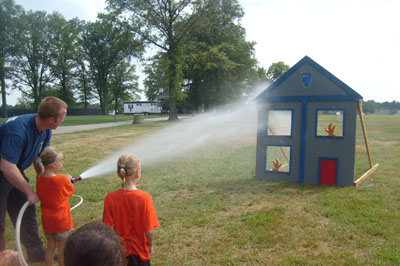
What Your Child Will Experience
Each day begins by getting the creative energy flowing in the art room while we wait for everyone to arrive. On the first day of the week the children are assigned counselors and remain in the same group for the entire week building their comfort and confidence. Once everyone is there all the groups are escorted to the main room for a special guest speaker covering the theme of the day. Themes include Police Officers Are Our Friends, Bicycle Safety, Pet and Animal Safety, Bus Safety and Fire Safety.
After listening to the guest speaker the children rotate through five different stations. These stations remain constant throughout the week except for Friday. Each station usually lasts approximately 15 minutes and reinforces their skills as well as a much needed energy outlet. Each group rotates through every station once each day.
The day concludes when all of the groups have rotated through each of the stations and we all meet in the main room. Our helmets and snack bags are gathered and we talk about what we learned from our guest speaker concerning the theme for that day. Goodie bags are given out that contain a reward and information focused on the theme of the day. Children are then released to their parents as we eagerly await the next day of fun and learning about safety.
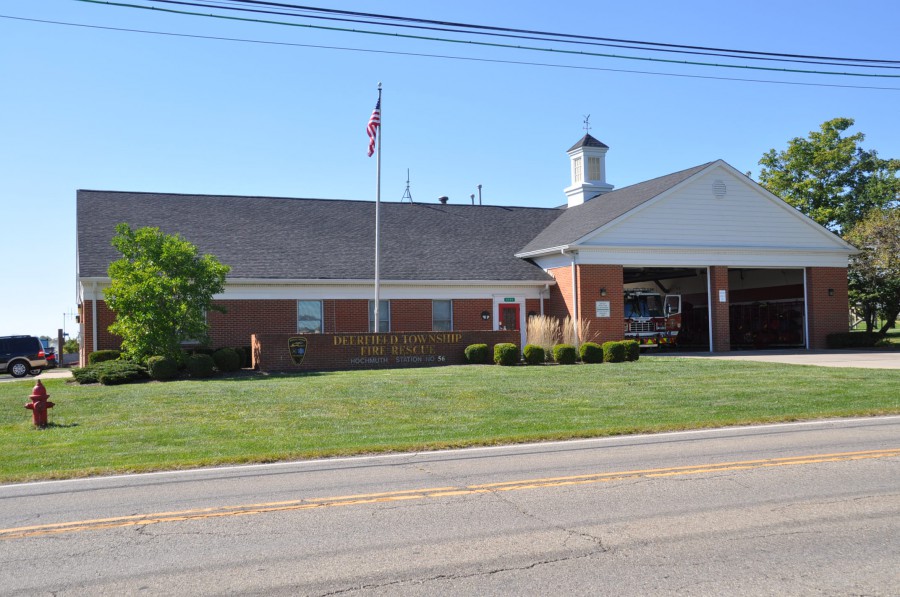
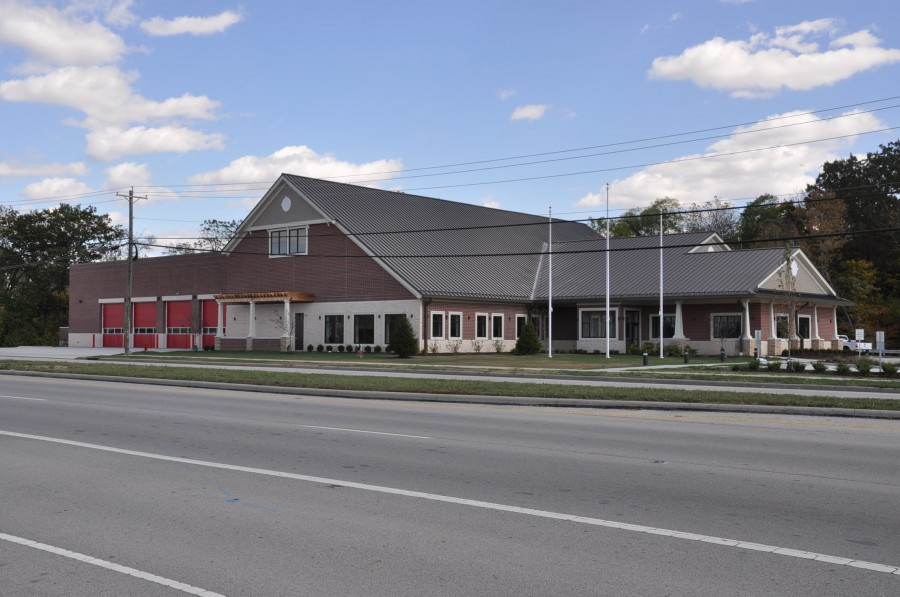
Fire Station 56 | 513.398.0169 option 2
Location: 8395 Snider Road, Mason, OH 45040
Station 56 staffs an Engine Company and an ALS Ambulance (Medic Unit). Station 56 protects the Socialville region of Deerfield Township, from our southern and western borders to the city corporation line and Interstate 71. Station 56 services all Deerfield Township sub-divisions off of Butler-Warren Road and south of Tylersville Road.
Apparatus for 56
- Engine
- Ambulance
.jpg)
Why is open burning a problem?
Open burning can release many kinds of toxic fumes. Leaves and plant materials send aloft millions of spores when they catch fire, causing many people with allergies to have difficulty breathing. The pollutants released by open burning also make it more difficult to meet health-based air quality standards, especially in or near large cities. The gases released by open burning can also corrode metal siding and damage paint on buildings.
What open burning is never allowed? Under Ohio law, these materials may not be burned anywhere in the state at any time:
- garbage—any wastes created in the process of handling, preparing, cooking or consuming food;
- materials containing rubber, grease and asphalt or made from petroleum, such as tires, cars and auto parts, plastics or plasticcoated wire; and
- dead animals—unless approved for control of disease by a governing agency.
Other restrictions:
- Open burning is not allowed when air pollution warnings, alerts or emergencies are in effect.
- Fires cannot obscure visibility for roadways, railroad tracks or air fields.
- No wastes generated off the premises may be burned. For example, a tree trimming contractor may not haul branches and limbs to another site to burn.
Does Ohio EPA ever allow exceptions to the rules?
Under certain circumstances, yes. However, to burn a prohibited material or set a fire in a restricted area, you must receive written permission from Ohio EPA before you begin burning. This may take two weeks.
What happens if I’m caught illegally open burning?
Ohio EPA has the authority to enforce the state’s open burning laws. Violations can result in substantial penalties. If you have any questions, or would like to report a suspected open burning incident, contact your Ohio EPA district office or your local air pollution control agency.
Health Concerns
Burning household waste produces many toxic chemicals and is one of the largest known sources of dioxin in the nation. Other air pollutants from open burning include particulate matter, sulfur dioxide, lead and mercury. These pollutants have been linked to several health problems, including asthma, respiratory illnesses, nervous system damage, kidney and liver damage, and reproductive or developmental disorders.
More information can be found at the links below:
FAQs
Fire Department Operational Personnel
Unit 1
Deputy Chief Marc Brinker
| Lt. Matt Young | Lt. Taylor Wood | Cpt. James Butler | Lt. Adam Farwick |
| Richard Panek | Noa Sidley | Bryant Davis | Josh Dickhaus |
| Johnny Hess | Adam Gilpin | Chris Kilgus | Ian Smith |
| Olivia Monroe | Steven Hill | Tyler Polen | Jake Hanselman |
| Ryan Hurley | Logan Grout | Hunter Ward | |
| Jerod Akers | Luke Wade | ||
Unit 2
Deputy Chief Dan James
| Cpt. Nick Rose | Lt. Brad Schlake | Lt. Andy Burwinkel | Cpt. Dan Seiler |
| Jacob Carlier | Brad Crowthers | Matt Shelton | Michael Dulovich |
| Christian Clark | John Balbach | Pat Jennings | Evan Peul |
| Zach Camburn | Brian Welshans | Jacob Vonder Meulen | Thomas Fraizer |
| Russell Walker | Spencer Bultman | Emilie Ziese | Adam Horman |
| Jackson Adams | Collin Mellendorf | ||
Unit 3
Deputy Chief Jason Todd
| Lt. Ryan Haines | Cpt. Leonard Brooks | Lt. Ryan Tucker | Lt. Bob Hines |
| Chris Adkins | James Toth | Brian Bentley | Russ Stansell |
| Brady Bogan | Kevin Wedding | Brandon Hills | Jesse Campbell |
| Sam Queen | Brad Mullins | Tyson Farlaino | Brandon Lynch |
| Aaron Bryant | Brad Jones | Josh Crowthers | Kevin Rogers |
| James Reist | Jared Karrasch | ||
40 Hour Staff
- Captain Patrick Strausbaugh
- Lieutenant Joe McElroy
Special Operations
Specialty Teams
- Warren County Fire Investigation Team
- Warren County Technical Rescue Team
- Hamilton County USAR
- Hamilton County Fire Investigation Team
- FEMA Ohio Task Force 1
EMS Operations
- Billing
- Patient's Rights
- Records Request
Fleet Maintenance
Home Fire Inspections
Deerfield Township Fire Rescue offers home fire safety inspections to support both families going through the adoption process and homeowners who simply want to make their homes safer.
For adoptions, a home fire inspection can help meet agency or court requirements by documenting that basic fire safety measures are in place. Inspectors will look at items such as working smoke detectors, clear exits, address visibility, fire extinguishers (if present), and general household fire safety practices. The goal is to help ensure a safe environment for children and to provide guidance on simple improvements if needed.
Homeowners may also request a fire safety inspection even if it is not required. During these visits, fire personnel can walk through the home, point out potential hazards, discuss evacuation planning, and answer questions about smoke detectors, carbon monoxide detectors, and other fire safety concerns. It’s a proactive way for residents to reduce risk and gain peace of mind.
To request a home fire inspection for adoption purposes or as a homeowner, please email Patrick Strausbaugh at pstra@deerfieldtwp.com or call 513.583.4797. Patrick can explain what to expect, schedule an appointment, and provide any necessary documentation related to the inspection.
Fire Station 56 | 513.398.0169 option 2
Location: 8395 Snider Road, Mason, OH 45040
Station 56 staffs an Engine Company and an ALS Ambulance (Medic Unit). Station 56 protects the Socialville region of Deerfield Township, from our southern and western boarders to the city corporation line and Interstate 71. Station 56 also services all Deerfield Township sub-divisions off of Butler Warren Road and those south of Mason Road.
Recycling bins are located here and at Station 58
Apparatus for 56
- Engine
- Ambulance
- Public Education Trailer
My smoke detector is chirping and I can't reach it. Who do I call to change the batteries?
If you smell smoke or are unsure please phone 911. If you need assistance changing the batteries please phone the main station number at 513.459.0875.
Registration Information
Four sessions of Safety Town are offered in June each year; registration begins on May 1st for Deerfield Township residents.
Deerfield Township residents are eligible to register their children in any one of the two sessions offered at no cost. Safety Town has limited availability and we would like to provide everyone with the same opportunity to be a part of this event.
For more about Safety Town dates and registration please go to DeerfieldRec.com.
If you have any questions, please email Michael Dulovich at mdulo@deerfieldtwp.com.
Ride-A-Longs
Knox Boxes
Knox Boxes play an important role in helping Deerfield Township Fire Rescue respond quickly and safely to emergencies while reducing damage to doors and locks.
A Knox Box is a secure, fire department‑approved key box mounted on the exterior of a building. Inside, building owners place keys (and sometimes access cards or gate codes) that allow firefighters to enter quickly without forcing doors when responding to alarms, fires, or medical emergencies.
Commercial properties
On commercial properties, Knox Boxes are required as part of fire code. Having a Knox Box on your building helps firefighters:
- Gain rapid access when an alarm is activated, even after hours
- Check for fire or smoke conditions without breaking doors or windows
- Minimize damage and downtime for the business
Business owners are responsible for keeping the keys inside the Knox Box up to date any time locks are changed.
Residential properties
For residential properties, Knox Boxes are optional but strongly recommended for certain situations, such as:
- Seniors or residents with mobility or medical challenges
- Homes that participate in special access programs for EMS
- Gated communities or properties where quick access may be difficult
A residential Knox Box allows firefighters and paramedics to enter the home more quickly during an emergency, which can be especially important when seconds matter. It also helps avoid broken doors and locks when crews must gain access rapidly.
Residents and business owners typically purchase approved Knox Box devices directly from the manufacturer, following local fire department guidelines for type and placement.
Once installed, the box location is recorded by the department so responding crews know exactly where to find it.
If you have questions, please email Patrick Strausbaugh at pstra@deerfieldtwp.com or call 513.583.4797.
You can also visit Knox Box’s official website at Emergency Key Box - Knox Rapid Access System
Seasonal Reminders - Every season brings about new cautions and awareness pertaining to fire and safety. Please read up to stay informed and be safe throughout the year. Click here to read seasonal reminders.
Spring
Check your Clocks and Batteries
It's time for a change! Change your clocks and batteries...
When it’s time to "spring forward" and change the clocks, make sure to change the batteries in all of your smoke alarms. If batteries were recently changed, it's still very important to conduct your monthly test of your smoke alarms. It could save a life! Did you know that having a working smoke alarm reduces a person's chance of dying in a fire by half? For the best protection, install smoke alarms on every level of your home, outside every sleeping area and in every bedroom. Smoke alarms should be mounted high on walls or ceilings and tested monthly. It's important to replace smoke alarm batteries at least once a year, unless they're 10 year lithium batteries. Even if your smoke alarms are hardwired, replace the batteries in case of a chirping sound or a power outage. Reminder: Smoke alarms do not last forever. The maximum life span is 8-10 years. After that time, the entire unit should be replaced. If the unit does not respond properly when tested, it should be replaced immediately.
Spring Cleaning
Try these safety techniques to prevent spring cleaning injuries:
- Remember to take frequent breaks and stay hydrated as you complete your cleaning project.
- Get help for moving heavy furniture.
- Clean the floor with a mop rather than on your hands and knees. Push the mop forward and back to clean small areas at a time, rather than leaning too far forward.
- If you must scrub floors by hand, kneel on a pad and don’t reach too far in any direction.
- Vacuuming can put a lot of strain on the spine and neck. Keep the hose in front of your body at waist height, use both hands to push the vacuum, and walk straight across the carpet, then turn and go back. Avoid pushing and pulling in short little strokes.
- For bathtub cleaning, stand outside the tub with a long mop rather than sitting and leaning over the side.
- If you're washing high windows, use a secure ladder or step stool to stay level with the window rather than stretching your back and neck upwards for long periods of time. The same goes for painting.
- Lift items such as mulch, flower pots and other heavy objects by bending your knees and lifting with your legs rather than your back. Keep items close to your body and use both hands.
- Pull weeds with your legs and abdominal muscles tightened .
- Spring cleaning can be great exercise. Consider it a workout instead of work!
Summer
Memorial Day and Fourth of July
Ohio’s New Fireworks Law (July 1, 2022)
Fireworks Safety
- The only types of fireworks that can be legally purchased and discharged in Ohio are trick and novelty devices. These include items that smoke, sparkle, snap and snake.
- Handle and discharge trick and novelty devices only under adult supervision.
- Appoint one adult to be in charge. This person should know the hazards of each type of firework being used.
- Carefully read and follow the label directions on the trick and novelty device packaging.
- Light only one sparkler at a time and hold it away from your body and others.
- Sparkler wires, which can burn up to 1800 degrees, should immediately be placed in a bucket of water to avoid injury as they remain hot for a few minutes after burnout.
- If someone gets burned, run cool water over the wound for two or three minutes and seek medical attention when necessary.
Campfire Safety
- Build where they will not spread; away from dry grass, leaves and never under overhanging trees.
- Keep campfires small, and don’t let them get out of hand.
- Keep plenty of water and a shovel around to douse the fire when you’re done. Stir it and douse it again with water.
- Never leave campfires unattended.
- It is important to follow the park’s rules for the use and extinguishing of campfires.
- Never start a without having the equipment and ability to extinguish it.
Barbecue Safety
- Before using a grill, check the connection between the propane tank and the fuel line.
- Do not overfill the propane tank.
- Do not wear loose clothing while cooking at a barbecue.
- Be careful when using lighter fluid. Do not add fluid to an already lit fire because the flame can flashback up into the container and explode.
- Keep all matches and lighters away from children. Teach your children to report any loose matches or lighters to an adult immediately. Supervise children around outdoor grills.
- Dispose of hot coals properly - douse them with plenty of water, and stir them to ensure that the fire is out. Never place them in plastic, paper or wooden containers.
- Never grill/barbecue in enclosed areas - carbon monoxide could be produced.
- Make sure everyone knows to Stop, Drop and Roll in case a piece of clothing does catch fire. Call 911 or your local emergency number if a burn warrants medical attention. All burns to the face, hands, feet or groin require medical attention.
Fall
Halloween Safety
Walk Safely
- Cross the street at corners, using traffic signals and crosswalks.
- Look left, right and left again when crossing and keep looking as you cross.
- Put electronic devices down and keep heads up and walk, don’t run, across the street.
- Teach children to make eye contact with drivers before crossing in front of them.
- Always walk on sidewalks or paths. If there are no sidewalks, walk facing traffic as far to
the left as possible. Children should walk on direct routes with the fewest street crossings. - Watch for cars that are turning or backing up. Teach children to never dart out into the street or cross between parked cars.
Trick or Treat With an Adult
- Children under the age of 12 should not be alone at night without adult supervision. If kids are mature enough to be out without supervision, they should stick to familiar areas that are well lit and trick-or-treat in groups.
Keep Costumes Both Creative and Safe
- Decorate costumes and bags with reflective tape or stickers and, if possible, choose light colors.
- Choose face paint and makeup whenever possible instead of masks, which can obstruct a child’s vision.
- Have kids carry glow sticks or flashlights to help them see and be seen by drivers.
- When selecting a costume, make sure it is the right size to prevent trips and falls.
Drive Extra Safely on Halloween
- Slow down and be especially alert in residential neighborhoods. Children are excited on Halloween and may move in unpredictable ways.
- Take extra time to look for kids at intersections, on medians and on curbs.
- Enter and exit driveways and alleys slowly and carefully.
- Eliminate any distractions inside your car so you can concentrate on the road and your surroundings.
- Drive slowly, anticipate heavy pedestrian traffic and turn your headlights on earlier in the day to spot children from greater distances.
- Popular trick-or-treating hours are 5:30 p.m. to 9:30 p.m. so be especially alert for kids during those hours.
Winter
Carbon Monoxide
Often called the invisible killer, carbon monoxide (CO) is an odorless, colorless gas created when fuels such as gasoline, wood, coal, propane, etc. do not burn completely. In the home, heating and cooking equipment that burn fuel are potential sources of CO. Carbon monoxide incidents are more common during the winter months, and in residential property.
Winter Storms
Most of the U.S. is at risk for winter storms, which can cause dangerous and sometimes life-threatening conditions. Blinding wind-driven snow, extreme cold, icy road conditions, downed trees and power lines can all wreak havoc on our daily schedules. Home fires occur more in the winter than in any other season, and heating equipment is involved in one of every six reported home fires, and one in every five home fire deaths.
Generators
Portable generators are useful during power outages, however, many homeowners are unaware that the improper use of portable generators can be risky. The most common dangers associated with portable generators are carbon monoxide (CO) poisoning, electrical shock or electrocution, and fire hazards. According to a 2013 Consumer Product Safety Commission report, half of the generator-related deaths happened in the four coldest months of the year, November through February, and portable generators were involved in the majority of carbon monoxide deaths involving engine-driven tools.
Candles
December is the peak time of year for home candle fires; the top three days for home candle fires are Christmas, New Year’s Day, and New Year’s Eve. Each year between 2012 and 2016, an average of 8,200 home candle fires were reported each year. More statistics on candle fires.
Electrical
Electrical home fires are a leading cause of home fires in the U.S. Roughly half of all home electrical fires involved electrical distribution or lighting equipment, while nearly another half involved other known types of equipment like washer or dryer fans, and portable or stationary space heaters
Heating
In 2011-2015, heating equipment was involved in an estimated 54,030 reported U.S. home structure fires, with associated losses of 480 civilian deaths, 1,470civilian injuries, and $1.1 billion in direct property damage. These fires accounted for 15% of all reported home fires.
Facts & Figures
Based on 2011-2015 annual averages:
- Space heaters, whether portable or stationary, accounted for just over two of every five (43%) of home heating fires and four out of five (85%) of home heating fire deaths.
- The leading factor contributing to home heating fires (28%) was failure to clean, principally creosote from solid-fueled heating equipment, primarily chimneys.
- Placing things that can burn too close to heating equipment or placing heating equipment too close to things that can burn, such as upholstered furniture, clothing, mattress, or bedding, was the third leading factor contributing to ignition in fatal home heating fires and accounted for more than half (53%) of home heating fire deaths.
- Keep anything that can burn at least 3ft from heating equip (furnace, fireplace, wood stove, portable heater)
- Nearly half (48%) of all home heating fires occurred in December, January and February.
- Inspect and maintain heating equipment regularly for safety.
- Be sure to have fixed space heaters installed by a qualified technician, according to manufacturer’s instructions or applicable codes. Or, make sure a qualified technician checks to see the unit has been properly installed.
- When buying a new, portable space heater, make sure it has the label showing it is listed by a recognized testing laboratory, such as Underwriters Laboratories (UL).
- Space heaters should be turned off every time you leave the room and before going to bed.
- Choose space heaters that turn off automatically if they tip over.
- Never use a space heater to dry clothing.
- Do not use your oven to heat your home.
- Install smoke alarms in every bedroom, outside each sleeping area, and on every level of the home. For the best protection, interconnect all smoke alarms throughout the home. When one sounds, they all sound.
- Test smoke alarms monthly.
Fire Station 57 | 513.697.2744 option 2
Location: 3435 U.S. Route 22 & 3, Loveland, OH 45140
Station 57 staffs a Ladder Company and an ALS Ambulance (Medic Unit). Station 57 protects Loveland Park, Landen, and the Maineville portion of Deerfield Township, from our southern and eastern boarders to Western Row. Ladder 57 crew also cross staffs our Technical Rescue Unit. Station 57 is the Department’s Headquarters, housing the Fire Chief and Battalion Chiefs, in addition to support services and the Department’s fleet maintenance facility.
Check out the design-build process through our Deerfield Township Youtube channel here at the Township.
Recycling bins are located at Station 56 & Station 58
Apparatus for 57
- Ladder Truck
- Engine
- Two Ambulances
- Rescue Truck
- Hazmat Trailer

Themes
- Monday: Bike Safety
- Tuesday: Police Officers are our Friends
- Wednesday: Bus Safety
- Thursday: Pet Safety
- Friday: Fire Safety
Daily Stations
Station One: Safety Town Tricycles
Children practice riding their tricycles through the streets of Safety Town. Wearing their bicycle helmets they learn hand signals and the rules of the road.
Station Two: Snack Time
After navigating the streets of Safety Town safely it is time for a snack. Children bring a light snack while they rest and watch a safety video geared toward the theme of the day.
Station Three: 9-1-1 Phones
This is where the children learn to dial 9-1-1 and talk to a live (counselor) operator. We practice writing out our name, address and phone number then call 9-1-1 and repeat our information so the operator can send help.
Station Four: Playground
After saving the day by calling 9-1-1 it is time to celebrate and play on the playground while practicing all of our safety rules.
Station Five: Creative Art
The theme of the day is expressed in your child’s
Fire Station 57 | 513.697.2744 option 2
Location: 3435 U.S. Route 22 & 3, Loveland, OH 45140
Station 57 staffs a Ladder Company and an ALS Ambulance (Medic Unit). Station 57 protects Loveland Park, Landen, and the Maineville portion of Deerfield Township, from our southern and eastern boarders to Western Row. Ladder 57 crew also cross staffs our Heavy Rescue Unit and a Regional Hazardous Material Unit. Station 57 is the Department’s Headquarters, housing the Fire Chief and Deputy Chiefs.
Station 57 now offers the Ohio Safe Haven Baby Box.
Check out the design-build process through our Deerfield Township Youtube channel here at the Township.
Apparatus for 57
- Ladder Truck
- Engine
- Ambulances
- Rescue Truck
- Hazmat Trailer
Contact Us
Fire Prevention Resources
Did you know?
Fire Prevention Week starts the first Sunday in October commemorating the great Chicago fire. Each year there is a new theme emphasizing different fire safety practices.
Seasonal Reminders - Every season brings about new cautions and awareness pertaining to fire and safety. Please read up to stay informed and be safe throughout the year. Click here to read seasonal reminders.
Spring
Check your Clocks and Batteries
It's time for a change! Change your clocks and batteries...
When it’s time to "spring forward" and change the clocks, make sure to change the batteries in all of your smoke alarms. If batteries were recently changed, it's still very important to conduct your monthly test of your smoke alarms. It could save a life! Did you know that having a working smoke alarm reduces a person's chance of dying in a fire by half? For the best protection, install smoke alarms on every level of your home, outside every sleeping area and in every bedroom. Smoke alarms should be mounted high on walls or ceilings and tested monthly. It's important to replace smoke alarm batteries at least once a year, unless they're 10 year lithium batteries. Even if your smoke alarms are hardwired, replace the batteries in case of a chirping sound or a power outage. Reminder: Smoke alarms do not last forever. The maximum life span is 8-10 years. After that time, the entire unit should be replaced. If the unit does not respond properly when tested, it should be replaced immediately.
Spring Cleaning
Try these safety techniques to prevent spring cleaning injuries:
- Remember to take frequent breaks and stay hydrated as you complete your cleaning project.
- Get help for moving heavy furniture.
- Clean the floor with a mop rather than on your hands and knees. Push the mop forward and back to clean small areas at a time, rather than leaning too far forward.
- If you must scrub floors by hand, kneel on a pad and don’t reach too far in any direction.
- Vacuuming can put a lot of strain on the spine and neck. Keep the hose in front of your body at waist height, use both hands to push the vacuum, and walk straight across the carpet, then turn and go back. Avoid pushing and pulling in short little strokes.
- For bathtub cleaning, stand outside the tub with a long mop rather than sitting and leaning over the side.
- If you're washing high windows, use a secure ladder or step stool to stay level with the window rather than stretching your back and neck upwards for long periods of time. The same goes for painting.
- Lift items such as mulch, flower pots and other heavy objects by bending your knees and lifting with your legs rather than your back. Keep items close to your body and use both hands.
- Pull weeds with your legs and abdominal muscles tightened .
- Spring cleaning can be great exercise. Consider it a workout instead of work!
Summer
Memorial Day and Fourth of July
Ohio’s New Fireworks Law (July 1, 2022)
Fireworks Safety
- The only types of fireworks that can be legally purchased and discharged in Ohio are trick and novelty devices. These include items that smoke, sparkle, snap and snake.
- Handle and discharge trick and novelty devices only under adult supervision.
- Appoint one adult to be in charge. This person should know the hazards of each type of firework being used.
- Carefully read and follow the label directions on the trick and novelty device packaging.
- Light only one sparkler at a time and hold it away from your body and others.
- Sparkler wires, which can burn up to 1800 degrees, should immediately be placed in a bucket of water to avoid injury as they remain hot for a few minutes after burnout.
- If someone gets burned, run cool water over the wound for two or three minutes and seek medical attention when necessary.
Campfire Safety
- Build where they will not spread; away from dry grass, leaves and never under overhanging trees.
- Keep campfires small, and don’t let them get out of hand.
- Keep plenty of water and a shovel around to douse the fire when you’re done. Stir it and douse it again with water.
- Never leave campfires unattended.
- It is important to follow the park’s rules for the use and extinguishing of campfires.
- Never start a without having the equipment and ability to extinguish it.
Barbecue Safety
- Before using a grill, check the connection between the propane tank and the fuel line.
- Do not overfill the propane tank.
- Do not wear loose clothing while cooking at a barbecue.
- Be careful when using lighter fluid. Do not add fluid to an already lit fire because the flame can flashback up into the container and explode.
- Keep all matches and lighters away from children. Teach your children to report any loose matches or lighters to an adult immediately. Supervise children around outdoor grills.
- Dispose of hot coals properly - douse them with plenty of water, and stir them to ensure that the fire is out. Never place them in plastic, paper or wooden containers.
- Never grill/barbecue in enclosed areas - carbon monoxide could be produced.
- Make sure everyone knows to Stop, Drop and Roll in case a piece of clothing does catch fire. Call 911 or your local emergency number if a burn warrants medical attention. All burns to the face, hands, feet or groin require medical attention.
Fall
Halloween Safety
Walk Safely
- Cross the street at corners, using traffic signals and crosswalks.
- Look left, right and left again when crossing and keep looking as you cross.
- Put electronic devices down and keep heads up and walk, don’t run, across the street.
- Teach children to make eye contact with drivers before crossing in front of them.
- Always walk on sidewalks or paths. If there are no sidewalks, walk facing traffic as far to
the left as possible. Children should walk on direct routes with the fewest street crossings. - Watch for cars that are turning or backing up. Teach children to never dart out into the street or cross between parked cars.
Trick or Treat With an Adult
- Children under the age of 12 should not be alone at night without adult supervision. If kids are mature enough to be out without supervision, they should stick to familiar areas that are well lit and trick-or-treat in groups.
Keep Costumes Both Creative and Safe
- Decorate costumes and bags with reflective tape or stickers and, if possible, choose light colors.
- Choose face paint and makeup whenever possible instead of masks, which can obstruct a child’s vision.
- Have kids carry glow sticks or flashlights to help them see and be seen by drivers.
- When selecting a costume, make sure it is the right size to prevent trips and falls.
Drive Extra Safely on Halloween
- Slow down and be especially alert in residential neighborhoods. Children are excited on Halloween and may move in unpredictable ways.
- Take extra time to look for kids at intersections, on medians and on curbs.
- Enter and exit driveways and alleys slowly and carefully.
- Eliminate any distractions inside your car so you can concentrate on the road and your surroundings.
- Drive slowly, anticipate heavy pedestrian traffic and turn your headlights on earlier in the day to spot children from greater distances.
- Popular trick-or-treating hours are 5:30 p.m. to 9:30 p.m. so be especially alert for kids during those hours.
Winter
Carbon Monoxide
Often called the invisible killer, carbon monoxide (CO) is an odorless, colorless gas created when fuels such as gasoline, wood, coal, propane, etc. do not burn completely. In the home, heating and cooking equipment that burn fuel are potential sources of CO. Carbon monoxide incidents are more common during the winter months, and in residential property.
Winter Storms
Most of the U.S. is at risk for winter storms, which can cause dangerous and sometimes life-threatening conditions. Blinding wind-driven snow, extreme cold, icy road conditions, downed trees and power lines can all wreak havoc on our daily schedules. Home fires occur more in the winter than in any other season, and heating equipment is involved in one of every six reported home fires, and one in every five home fire deaths.
Generators
Portable generators are useful during power outages, however, many homeowners are unaware that the improper use of portable generators can be risky. The most common dangers associated with portable generators are carbon monoxide (CO) poisoning, electrical shock or electrocution, and fire hazards. According to a 2013 Consumer Product Safety Commission report, half of the generator-related deaths happened in the four coldest months of the year, November through February, and portable generators were involved in the majority of carbon monoxide deaths involving engine-driven tools.
Candles
December is the peak time of year for home candle fires; the top three days for home candle fires are Christmas, New Year’s Day, and New Year’s Eve. Each year between 2012 and 2016, an average of 8,200 home candle fires were reported each year. More statistics on candle fires.
Electrical
Electrical home fires are a leading cause of home fires in the U.S. Roughly half of all home electrical fires involved electrical distribution or lighting equipment, while nearly another half involved other known types of equipment like washer or dryer fans, and portable or stationary space heaters
Heating
In 2011-2015, heating equipment was involved in an estimated 54,030 reported U.S. home structure fires, with associated losses of 480 civilian deaths, 1,470civilian injuries, and $1.1 billion in direct property damage. These fires accounted for 15% of all reported home fires.
Facts & Figures
Based on 2011-2015 annual averages:
- Space heaters, whether portable or stationary, accounted for just over two of every five (43%) of home heating fires and four out of five (85%) of home heating fire deaths.
- The leading factor contributing to home heating fires (28%) was failure to clean, principally creosote from solid-fueled heating equipment, primarily chimneys.
- Placing things that can burn too close to heating equipment or placing heating equipment too close to things that can burn, such as upholstered furniture, clothing, mattress, or bedding, was the third leading factor contributing to ignition in fatal home heating fires and accounted for more than half (53%) of home heating fire deaths.
- Keep anything that can burn at least 3ft from heating equip (furnace, fireplace, wood stove, portable heater)
- Nearly half (48%) of all home heating fires occurred in December, January and February.
- Inspect and maintain heating equipment regularly for safety.
- Be sure to have fixed space heaters installed by a qualified technician, according to manufacturer’s instructions or applicable codes. Or, make sure a qualified technician checks to see the unit has been properly installed.
- When buying a new, portable space heater, make sure it has the label showing it is listed by a recognized testing laboratory, such as Underwriters Laboratories (UL).
- Space heaters should be turned off every time you leave the room and before going to bed.
- Choose space heaters that turn off automatically if they tip over.
- Never use a space heater to dry clothing.
- Do not use your oven to heat your home.
- Install smoke alarms in every bedroom, outside each sleeping area, and on every level of the home. For the best protection, interconnect all smoke alarms throughout the home. When one sounds, they all sound.
- Test smoke alarms monthly.
Seasonal Holiday Safety Tips
With the holidays in full swing, it’s important to remember we want to Keep the Wreath Red, a safety program Deerfield Township Fire Rescue will once again promote this year to remind residents that fires are often caused by holiday decorations.
Beginning in December each of our four township fire stations will display a wreath decorated with illuminated red bulbs. If a fire is caused directly by holiday decorations, one red bulb will be changed to a white bulb. Since 2012 all of our wreaths have stayed red. Please help us keep this tradition in the red.
Keep the Wreath Red originated in Illinois by Napervillle Firefighter Paul Boecker during the holiday season of 1954. Each year more fire departments across the country have joined in to make the holidays safer and happier. Deerfield Township Fire Rescue encourages everyone to follow these safety tips during the holidays from the National Fire Protection Association (NFPA)
Safety Tips for the Season
Christmas Trees
Type of tree
Consider an artificial tree, which is much safer and cleaner.
Select only fresh trees that are deep green in color, have a strong scent of pine, and do not lose their needles readily.
Keep trees in water-holding stands and keep stands full of water.
Do not rely on chemical sprays to make your tree flame resistant.
Place trees away from heat sources and a safe distance from exits.
Lights
Maintain Your Holiday Lights
Inspect holiday lights each year for frayed wires, bare spots, gaps in the insulation, broken or cracked sockets, and excessive kinking or wear before putting them up. Use only lighting listed by an approved testing laboratory.
Do Not Overload Electrical Outlets
Do not link more than three light strands, unless the directions indicate it is safe. Connect strings of lights to an extension cord before plugging the cord into the outlet. Make sure to periodically check the wires – they should not be warm to the touch.
Discard any lights that have frayed or worn cords, broken or cracked sockets,
loose connections, bare wires or operate intermittently.
Buy and use lights approved by a national testing laboratory.
Do not leave holiday lights on unattended!
Holiday Decorations
Use Only Nonflammable Decorations
All decorations should be nonflammable or flame-retardant and placed away from heat vents. If you are using a metallic or artificial tree, make sure it is flame retardant.
Never Put Lit Candles on a Tree
Do not go near a Christmas tree with an open flame – candles, lighters or matches.
Don't Block Exits
Ensure that trees and other holiday decorations do not block an exit way. In the event of a fire, time is of the essence. A blocked entry/exit way puts you and your family at risk.
Never Put Wrapping Paper in the Fireplace
Wrapping paper in the fireplace can result in a very large fire, throwing off dangerous sparks and embers that may result in a chimney fire.
Candle Care
Never Leave a Burning Candle Unattended
Consider using battery-operated flameless candles, which can look, smell and feel like real candles.
If You Do Use Lit Candles
Make sure candles are in stable holders and place them where they cannot be easily knocked down. Keep candles at least 12 inches from anything that can burn. Avoid using candles in bedrooms and sleeping areas.
Disposing of Your Tree
Never put tree branches or needles in a fireplace or wood-burning stove. When the tree becomes dry, discard it promptly. The best way to dispose of your tree is by taking it to a recycling center or having it hauled away by a community pick-up service.
Flood Safety - Most communities in the United States can experience some kind of flooding after spring rains, heavy thunderstorms or winter snow thaws. Floods can be slow or fast-rising, but generally develop over a period of days. Flash floods usually result from intense storms dropping large amounts of rain within a brief period. Flash flooding can occur with little or no warning and can reach its peak in only a few minutes.
Emergency Information
Flood waters can be extremely dangerous. The force of six inches of swiftly moving water can knock an adult person off his or her feet. The best protection during a flood is to leave the area and seek shelter on higher ground.
Flash flood waters move very quickly and can roll boulders, tear out trees, destroy buildings and obliterate bridges. Walls of water can reach heights of 10 to 20 feet and generally are accompanied by a deadly cargo of debris. The best response to any signs of flash flooding is to move immediately and quickly to higher ground.
Just two feet of moving water can float and carry away most vehicles, including sport utility vehicles (SUVs) and pickup trucks. You can protect yourself best by being prepared and having time to act.
Before a Flood
- Check with your local floodplain administrator to determine if you live in a flood-prone area.
- Consider installing check valves in building sewer traps to prevent flood waters from backing up in sewer drains.
- Plan and practice an evacuation route.
- Have disaster supplies on hand.
- Develop an emergency communication plan.
- Flood damage to vehicles is covered by auto insurance when comprehensive coverage is purchased.
During a Flood Watch
- Listen to a radio or television for the latest storm information.
- Fill bathtub, sinks and jugs with clean water in case water becomes contaminated.
- Move valuable household possessions to upper floors or to safe grounds if time permits.
- If you are instructed by local authorities, turn off all utilities at the main power switch and close the main gas valve.
- Be prepared to evacuate.
During a Flood Warning
- If indoors, turn on a battery-powered radio or NOAA Weather Radio to get the latest emergency information. If your area is advised to evacuate, do so immediately.
- If outdoors, climb to high ground and stay there. Avoid walking through any flood waters.
- If you are driving and have come to a flooded area, turn around and go the other way. Many deaths have resulted from attempts to drive through flooded roadways.
During an Evacuation
- If advised to evacuate, do so immediately.
- Evacuation is much simpler and safer before flood waters block your escape. Leave early enough to avoid being marooned by flooded roads.
- Never attempt to drive or walk through flood waters. Water could be deeper than it appears and floodwater currents can be deceptive. Remember, it only takes two feet of water to carry away most vehicles.
- Listen to Emergency Alert System (EAS) messages on the radio or television for evacuation instructions
- Follow recommended evacuation routes. Shortcuts may be blocked.
After a Flood
The hours immediately following a flood can be very confusing. When disaster strikes, the county emergency management agency and local government initiate rescue, evacuation and shelter missions and provide emergency assistance to meet the public’s immediate needs.
If the commissioners declare a state of emergency for the county, the local EMA may contact the Ohio EMA for assistance in coordinating state resources and response activities. Based on the extent of the incident, the governor may declare a state of emergency for the affected county(ies). If disaster damages exceed state and local capabilities, the governor may request the president to grant federal disaster assistance through FEMA.
- Before entering a flood-damaged building, check the foundation for cracks and inspect porch roofs and overhangs to be sure they are adequately supported. Ask a building inspector to check the house before you go inside.
- Be alert for gas leaks. Do not strike a match or use open flame when entering a building unless you know the gas has been turned off and the area ventilated.
- Do not use appliances or motors that have gotten wet unless they have been taken apart, cleaned and dried.
- For more information on floods or flood safety, contact your state or local emergency management agency; the Ohio Department of Natural Resources, Division of Water; the National Weather Service; or your local American Red Cross chapter.
For additional information on Ohio flooding and flood insurance, visit the following sites:
- FloodSmart.gov
- Ohio Insurance Institute
- Ohio Department of Insurance
- Ohio Department of Natural Resources, Floodplain Management
- Federal Emergency Management Agency
Additional Flood Safety Tips
- Evacuate areas that are subject to flooding. This includes dips, low spots, canyons,
washes, etc. - If driving, be aware that the road bed may not be intact under flood waters. Turn around
and go another way. NEVER drive through flooded roads or low water crossings. Rapidly rising waters may engulf the vehicle and sweep it away. - If camping, choose camp sites along waterways with care. Remember that storms that are miles away could bring raging water your way.
Flood Terminology
Flood – A condition that occurs when water overflows the natural or artificial confines of a stream or body of water, or accumulates by drainage over low-lying areas.
General River Flooding – follows heavy rain, snow melt or their combination. While river flooding typically occurs slowly, allowing more time to take protective measures, extreme flash flooding or a breakup of an ice jam along a river can produce more rapid river rises.
Urban and Small Stream Floods – occurs when heavy rain falls, resulting in flooded streets, underpasses or drainage ditches in urban areas, and creeks in rural areas. Not usually life-threatening on its own, but can be, if motorists drive through a flooded roadway or children play near a storm drain or drainage ditch.
Flash Floods – Rapid and life-threatening floods from heavy rains occurring in a short period of time, usually in hilly or mountainous areas, or produced by the failure of a dam.
Flood/Flash Flood Watch – Usually issued for several hours indicating that conditions are favorable for possible flooding or flash flooding.
Flood/Flash Flood Warning – Issued when flooding or flash flooding is imminent or occurring. This indicates a need to take protective measures.
Carbon Monoxide Safety - Carbon monoxide (CO) is a tasteless, odorless, and colorless gas known as the “silent killer.” Each year, more than 400 Americans die from unintentional CO poisoning, more than 20,000 visit the emergency room and more than 4,000 are hospitalized due to CO poisoning.
Heating Safety - FIRST AND FOREMOST: Having a working smoke alarm dramatically increases your chances of surviving a fire. And remember to practice a home escape plan frequently with your family.
Fireplaces
Fireplaces regularly build up creosote in their chimneys. They need to be cleaned out frequently and chimneys should be inspected for obstructions and cracks to prevent deadly chimney and roof fires. Check to make sure the damper is open before starting any fire. Never burn trash, paper or green wood in your fireplace. These materials cause heavy creosote buildup and are difficult to control. Use a screen heavy enough to stop rolling logs and big enough to cover the entire opening of the fireplace to catch flying sparks. Don't wear loose-fitting clothes near any open flame. Make sure the fire is completely out before leaving the house or going to bed. Allow ashes to cool before disposing of them. Place ashes in a tightly covered metal container and keep the ash container at least 10 feet away from your home and any other nearby buildings. Never empty the ash directly into a trash can. Douse and saturate the ashes with water.
Wood Stoves
Wood stoves cause over 4,000 residential fires every year. Carefully follow the manufacturer's installation and maintenance instructions. Look for solid construction, such as plate steel or cast iron metal. Check for cracks and inspect legs, hinges and door seals for smooth joints and seams. Use only seasoned wood for fuel, not green wood, artificial logs, or trash. In pellet stoves, burn only dry, seasoned wood pellets. Inspect and clean your pipes and chimneys annually and check monthly for damage or obstructions.
Electric Space Heaters
Buy only heaters evaluated by a nationally recognized laboratory, such as Underwriters Laboratories (UL). Check to make sure it has a thermostat control mechanism, and will switch off automatically if the heater falls over. Heaters are not dryers or tables; don't dry clothes or store objects on top of your heater. Plug space heaters directly into wall outlets and never into an extension cord or power strip. Always unplug your electric space heater when not in use.
Kerosene Heaters
Buy only heaters evaluated by a nationally recognized laboratory, such as Underwriters Laboratories (UL), and check with your local fire department on the legality of kerosene heater use in your community. Never fill your heater with gasoline or camp stove fuel; both flare-up easily. Only use crystal clear K-1 kerosene. When refueling, allow the appliance to cool first and then refuel outside. Never overfill any portable heater. Use the kerosene heater in a well ventilated room.
School Bus Safety -
Wishing everyone a safe start to the school year. Here are a few safety tips to remember on and around school busses: Click to Read
Welcome Back!
Drivers:
- Ohio law requires all vehicles must stop for school busses displaying red warning lights and stop sign anytime you are driving on a road that is less than four lanes wide.
- Driving on roads that are four or more lanes, only the traffic moving in the same direction as the bus are required to stop. Oncoming traffic does not have to stop, regardless of the existence of a median.
- Train tracks are the exception. You do not have to stop for the bus warning lights when the bus has stopped for train tracks.
- When stopping, maintain at least a 10 foot distance from the bus. Please keep this in mind when the bus turns on the yellow caution flashers.
- When at a stop sign and you are neither approaching nor following, the 10 foot rule applies and you must remain stopped.
- Stopped traffic must remain stopped until the bus has turned off red warning lights and stop sign.
School Bus Safety Tips for Students:
- At the Bus Stop: Always walk on the sidewalk to the bus stop, never run. If there is no sidewalk, walk on the left facing traffic.Go to the bus stop about five minutes before the bus is scheduled to arrive. While at the bus stop, wait quietly in a safe place well away from the road. Do not run and play while waiting.
- Getting On and Off the Bus:Enter the bus in line with younger students in front. Hold the handrail while going up and down the stairs.When entering the bus, go directly to a seat. Remain seated and face forward during the entire ride.
- Riding the Bus:Always speak quietly on the bus so the driver will not be distracted. Always be silent when a bus comes to a railroad crossing so the driver can hear if a train is coming.Never throw things on the bus or out the windows. Keep the aisles clear at all times. Feet should be directly in front of you on the floor and book bags should be kept on your lap. Large instruments or sports equipment should not block the aisle or emergency exits.Never play with the emergency exits. Large instruments or sports equipment should not block the aisle or emergency exits. If there is an emergency, listen to the driver and follow instructions.Hands should be kept to yourself at all times while riding on the bus. Fighting and picking on others creates a dangerous bus ride.
- Exiting the Bus:If you leave something on the bus, never return to the bus to get it. The driver may not see you come back and they may begin moving the bus. Make sure that drawstrings and other loose objects are secure before getting off the bus so that they do not get caught on the handrail or the door. Respect the "Danger Zone" which surrounds all sides of the bus. The "Danger Zone" is ten feet wide on all sides of the bus. Always remain 10 steps away from the bus to be out of the "Danger Zone" and where the driver can see you.Always cross the street in from of the bus. Never go behind the bus. If you drop something near the bus, tell the bus driver before you attempt to pick it up, so they will know where you are.Never speak to strangers at the bus stop and never get into the car with a stranger. Always go straight home and tell your parent or guardian.
Smoke Alarms - About 3,500 Americans die each year in fires and about 18,300 are injured. Many of them might be alive today if they had only learned what to do if there is a fire. It is very important to have a working smoke alarm with a working battery in your home. If you have that, it greatly lowers your chances of dying in a fire
How do I reach the Fire Department for non-emergency questions and scheduling?
513.459.0875
Administration
Fire Chief Chris Eisele
Chief Eisele began his fire service career in 1989 with the Miami Township Fire Department in Hamilton County. Chief Eisele was hired as Career Firefighter with the City of Forest Park in 1999. He was promoted to Lieutenant in 2002 and Captain in 2003. While at Forest Park, Chief Eisele began serving the citizens of Deerfield Township in December of 2000 as part-time Firefighter/Paramedic. Chief Eisele was promoted to the position of Career Battalion Chief with Deerfield in 2005 and was named Fire Chief in September 2008.
Chief Eisele graduated from Anna Marie College with a Masters of Public Administration in 2013 (Summa Cum Laude). Chief Eisele also holds a Bachelors Degree with honors in Fire Schiece from the University of Cincinnati and an Associate Degree in Fire Service Leadership from Cincinnati State Technical College where he graduated Magna Cum Laude.
Chief Eisele currently also serves as a adjunct Professor at the University of Cincinnati.
- Phone: 513.701.6962
- Email: reise@deerfieldtwp.com
Assistant Fire Chief Matt Hannigan
Chief Hannigan began his fire service career in 2004 with the Union Township – South Lebanon Fire Department in Warren County. Chief Hannigan was hired as a Career Firefighter with Deerfield Township in 2012. He was promoted to Lieutenant in 2018 and Captain in 2023. He was promoted to Deputy Chief in January of 2024 and Assistant Chief in May of 2025.
Chief Hannigan graduated from Anna Maria College with a Masters of Public Administration in 2024. Chief Hannigan also holds a Bachelors Degree from Bowling Green State University and an Associate Degree in Fire Science from Sinclair Community College.
Chief Hannigan is an active member on the Warren County Technical Rescue Team and serves on several committees with the Warren County Fire Chiefs Association.
- Phone: 513.583.4791
- Email: mhann@deerfieldtwp.com
(1).jpg)
Open Burning Guidelines
Why is open burning a problem?
Open burning can release many kinds of toxic fumes. Leaves and plant materials send aloft millions of spores when they catch fire, causing many people with allergies to have difficulty breathing. The pollutants released by open burning also make it more difficult to meet health-based air quality standards, especially in or near large cities. The gases released by open burning can also corrode metal siding and damage paint on buildings.
What open burning is never allowed? Under Ohio law, these materials may not be burned anywhere in the state at any time:
- garbage—any wastes created in the process of handling, preparing, cooking or consuming food;
- materials containing rubber, grease and asphalt or made from petroleum, such as tires, cars and auto parts, plastics or plasticcoated wire; and
- dead animals—unless approved for control of disease by a governing agency.
Other restrictions:
- Open burning is not allowed when air pollution warnings, alerts or emergencies are in effect.
- Fires cannot obscure visibility for roadways, railroad tracks or air fields.
- No wastes generated off the premises may be burned. For example, a tree trimming contractor may not haul branches and limbs to another site to burn.
Does Ohio EPA ever allow exceptions to the rules?
Under certain circumstances, yes. However, to burn a prohibited material or set a fire in a restricted area, you must receive written permission from Ohio EPA before you begin burning. This may take two weeks.
What happens if I’m caught illegally open burning?
Ohio EPA has the authority to enforce the state’s open burning laws. Violations can result in substantial penalties. If you have any questions, or would like to report a suspected open burning incident, contact your Ohio EPA district office or your local air pollution control agency.
Health Concerns
Burning household waste produces many toxic chemicals and is one of the largest known sources of dioxin in the nation. Other air pollutants from open burning include particulate matter, sulfur dioxide, lead and mercury. These pollutants have been linked to several health problems, including asthma, respiratory illnesses, nervous system damage, kidney and liver damage, and reproductive or developmental disorders.
More information can be found at the links below:
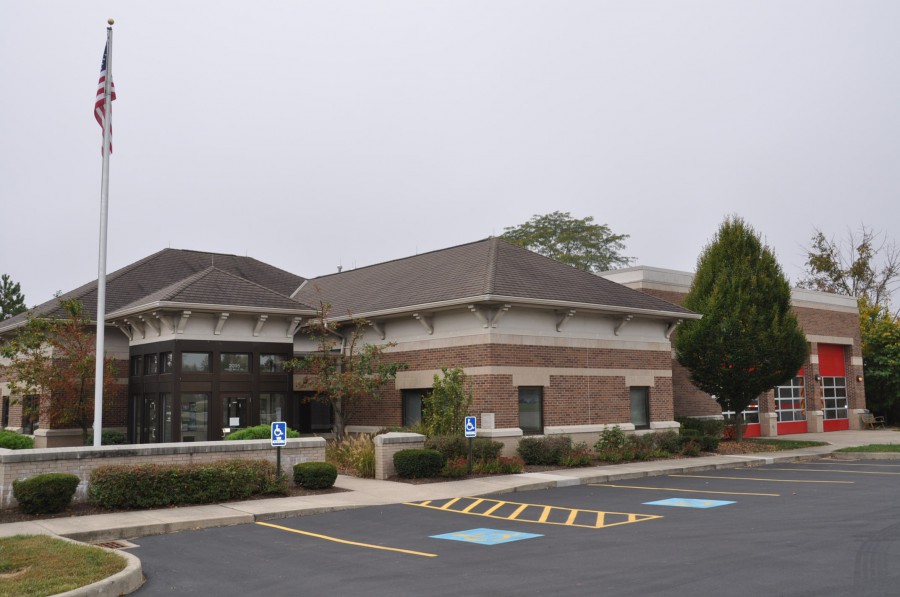
Fire Station 58 | 513.339.0558 option 2
Location: 2095 Kings Mills Road, Mason, OH 45040
Station 58 staffs an Engine Company and an ALS Ambulance (Medic Unit). Station 58 protects Kings Mills and through agreement with City of Mason is the first due ambulance and Engine Company to all areas of Mason, north of Kings Island and off of State Route 741.
Station 58 now offers the Ohio Safe Haven Baby Box.
Apparatus for 58
- Engine
- Ambulance
Seasonal Holiday Safety Tips
With the holidays in full swing, it’s important to remember we want to Keep the Wreath Red, a safety program Deerfield Township Fire Rescue will once again promote this year to remind residents that fires are often caused by holiday decorations.
Beginning in December each of our four township fire stations will display a wreath decorated with illuminated red bulbs. If a fire is caused directly by holiday decorations, one red bulb will be changed to a white bulb. Since 2012 all of our wreaths have stayed red. Please help us keep this tradition in the red.
Keep the Wreath Red originated in Illinois by Napervillle Firefighter Paul Boecker during the holiday season of 1954. Each year more fire departments across the country have joined in to make the holidays safer and happier. Deerfield Township Fire Rescue encourages everyone to follow these safety tips during the holidays from the National Fire Protection Association (NFPA)
Safety Tips for the Season
Christmas Trees
Type of tree
Consider an artificial tree, which is much safer and cleaner.
Select only fresh trees that are deep green in color, have a strong scent of pine, and do not lose their needles readily.
Keep trees in water-holding stands and keep stands full of water.
Do not rely on chemical sprays to make your tree flame resistant.
Place trees away from heat sources and a safe distance from exits.
Lights
Maintain Your Holiday Lights
Inspect holiday lights each year for frayed wires, bare spots, gaps in the insulation, broken or cracked sockets, and excessive kinking or wear before putting them up. Use only lighting listed by an approved testing laboratory.
Do Not Overload Electrical Outlets
Do not link more than three light strands, unless the directions indicate it is safe. Connect strings of lights to an extension cord before plugging the cord into the outlet. Make sure to periodically check the wires – they should not be warm to the touch.
Discard any lights that have frayed or worn cords, broken or cracked sockets,
loose connections, bare wires or operate intermittently.
Buy and use lights approved by a national testing laboratory.
Do not leave holiday lights on unattended!
Holiday Decorations
Use Only Nonflammable Decorations
All decorations should be nonflammable or flame-retardant and placed away from heat vents. If you are using a metallic or artificial tree, make sure it is flame retardant.
Never Put Lit Candles on a Tree
Do not go near a Christmas tree with an open flame – candles, lighters or matches.
Don't Block Exits
Ensure that trees and other holiday decorations do not block an exit way. In the event of a fire, time is of the essence. A blocked entry/exit way puts you and your family at risk.
Never Put Wrapping Paper in the Fireplace
Wrapping paper in the fireplace can result in a very large fire, throwing off dangerous sparks and embers that may result in a chimney fire.
Candle Care
Never Leave a Burning Candle Unattended
Consider using battery-operated flameless candles, which can look, smell and feel like real candles.
If You Do Use Lit Candles
Make sure candles are in stable holders and place them where they cannot be easily knocked down. Keep candles at least 12 inches from anything that can burn. Avoid using candles in bedrooms and sleeping areas.
Disposing of Your Tree
Never put tree branches or needles in a fireplace or wood-burning stove. When the tree becomes dry, discard it promptly. The best way to dispose of your tree is by taking it to a recycling center or having it hauled away by a community pick-up service.
Permits
Contact Patrick Strausbaugh at pstra@deerfieldtwp.com or call 513.583.4797 for permitting questions.
Flood Safety - Most communities in the United States can experience some kind of flooding after spring rains, heavy thunderstorms or winter snow thaws. Floods can be slow or fast-rising, but generally develop over a period of days. Flash floods usually result from intense storms dropping large amounts of rain within a brief period. Flash flooding can occur with little or no warning and can reach its peak in only a few minutes.
Emergency Information
Flood waters can be extremely dangerous. The force of six inches of swiftly moving water can knock an adult person off his or her feet. The best protection during a flood is to leave the area and seek shelter on higher ground.
Flash flood waters move very quickly and can roll boulders, tear out trees, destroy buildings and obliterate bridges. Walls of water can reach heights of 10 to 20 feet and generally are accompanied by a deadly cargo of debris. The best response to any signs of flash flooding is to move immediately and quickly to higher ground.
Just two feet of moving water can float and carry away most vehicles, including sport utility vehicles (SUVs) and pickup trucks. You can protect yourself best by being prepared and having time to act.
Before a Flood
- Check with your local floodplain administrator to determine if you live in a flood-prone area.
- Consider installing check valves in building sewer traps to prevent flood waters from backing up in sewer drains.
- Plan and practice an evacuation route.
- Have disaster supplies on hand.
- Develop an emergency communication plan.
- Flood damage to vehicles is covered by auto insurance when comprehensive coverage is purchased.
During a Flood Watch
- Listen to a radio or television for the latest storm information.
- Fill bathtub, sinks and jugs with clean water in case water becomes contaminated.
- Move valuable household possessions to upper floors or to safe grounds if time permits.
- If you are instructed by local authorities, turn off all utilities at the main power switch and close the main gas valve.
- Be prepared to evacuate.
During a Flood Warning
- If indoors, turn on a battery-powered radio or NOAA Weather Radio to get the latest emergency information. If your area is advised to evacuate, do so immediately.
- If outdoors, climb to high ground and stay there. Avoid walking through any flood waters.
- If you are driving and have come to a flooded area, turn around and go the other way. Many deaths have resulted from attempts to drive through flooded roadways.
During an Evacuation
- If advised to evacuate, do so immediately.
- Evacuation is much simpler and safer before flood waters block your escape. Leave early enough to avoid being marooned by flooded roads.
- Never attempt to drive or walk through flood waters. Water could be deeper than it appears and floodwater currents can be deceptive. Remember, it only takes two feet of water to carry away most vehicles.
- Listen to Emergency Alert System (EAS) messages on the radio or television for evacuation instructions
- Follow recommended evacuation routes. Shortcuts may be blocked.
After a Flood
The hours immediately following a flood can be very confusing. When disaster strikes, the county emergency management agency and local government initiate rescue, evacuation and shelter missions and provide emergency assistance to meet the public’s immediate needs.
If the commissioners declare a state of emergency for the county, the local EMA may contact the Ohio EMA for assistance in coordinating state resources and response activities. Based on the extent of the incident, the governor may declare a state of emergency for the affected county(ies). If disaster damages exceed state and local capabilities, the governor may request the president to grant federal disaster assistance through FEMA.
- Before entering a flood-damaged building, check the foundation for cracks and inspect porch roofs and overhangs to be sure they are adequately supported. Ask a building inspector to check the house before you go inside.
- Be alert for gas leaks. Do not strike a match or use open flame when entering a building unless you know the gas has been turned off and the area ventilated.
- Do not use appliances or motors that have gotten wet unless they have been taken apart, cleaned and dried.
- For more information on floods or flood safety, contact your state or local emergency management agency; the Ohio Department of Natural Resources, Division of Water; the National Weather Service; or your local American Red Cross chapter.
For additional information on Ohio flooding and flood insurance, visit the following sites:
- FloodSmart.gov
- Ohio Insurance Institute
- Ohio Department of Insurance
- Ohio Department of Natural Resources, Floodplain Management
- Federal Emergency Management Agency
Additional Flood Safety Tips
- Evacuate areas that are subject to flooding. This includes dips, low spots, canyons,
washes, etc. - If driving, be aware that the road bed may not be intact under flood waters. Turn around
and go another way. NEVER drive through flooded roads or low water crossings. Rapidly rising waters may engulf the vehicle and sweep it away. - If camping, choose camp sites along waterways with care. Remember that storms that are miles away could bring raging water your way.
Flood Terminology
Flood – A condition that occurs when water overflows the natural or artificial confines of a stream or body of water, or accumulates by drainage over low-lying areas.
General River Flooding – follows heavy rain, snow melt or their combination. While river flooding typically occurs slowly, allowing more time to take protective measures, extreme flash flooding or a breakup of an ice jam along a river can produce more rapid river rises.
Urban and Small Stream Floods – occurs when heavy rain falls, resulting in flooded streets, underpasses or drainage ditches in urban areas, and creeks in rural areas. Not usually life-threatening on its own, but can be, if motorists drive through a flooded roadway or children play near a storm drain or drainage ditch.
Flash Floods – Rapid and life-threatening floods from heavy rains occurring in a short period of time, usually in hilly or mountainous areas, or produced by the failure of a dam.
Flood/Flash Flood Watch – Usually issued for several hours indicating that conditions are favorable for possible flooding or flash flooding.
Flood/Flash Flood Warning – Issued when flooding or flash flooding is imminent or occurring. This indicates a need to take protective measures.
Fire Station 58 | 513.339.0558
Location: 2095 Kings Mills Road, Mason, OH 45040
Station 58 staffs an Engine Company and an ALS Ambulance (Medic Unit). Station 58 protects Kings Mills and through agreement with City of Mason is the first due ambulance and Engine Company to all areas of Mason, north of Kings Island and off of State Route 741. Also housed at Station 58 is MCU-158, a 100 person Mass Casualty Treatment Unit and part of UASI.
Recycling Bins are located here and at Station 56.
Apparatus for 58
- Engine
- Ambulance
- MCU 158
How do I get the Fire Department to inspect my business?
Please phone 513.678.2292 to schedule an inspection for your business.
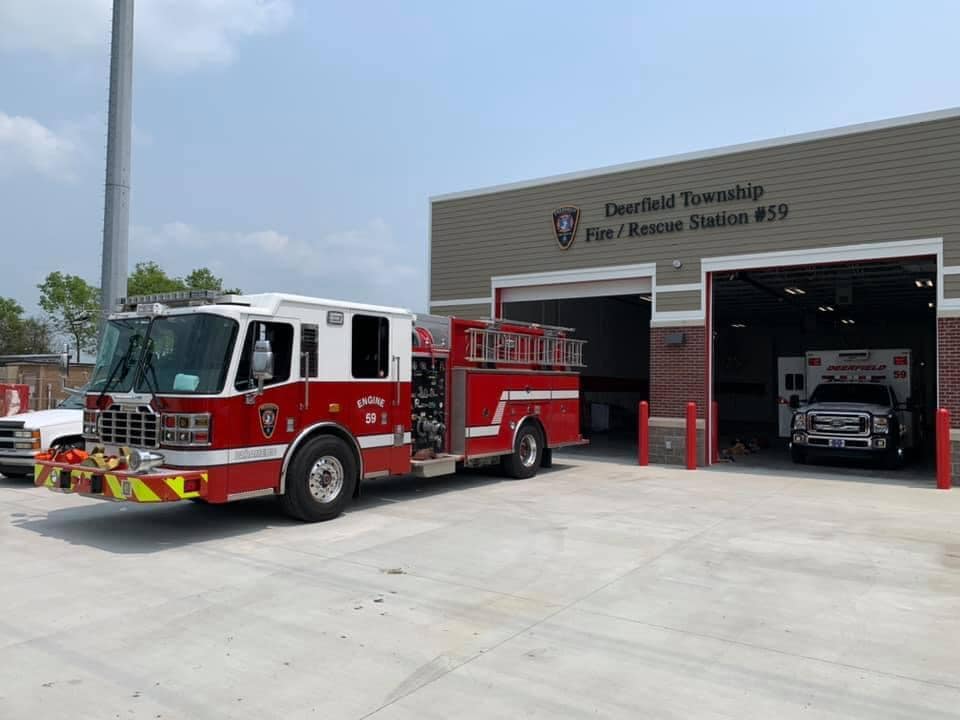
Fire Station 59 | 513.770.2388 option 2
Location: 3650 Butler Warren Rd, Mason, OH 45040
Station 59 staff an Engine Company and an ALS Ambulance (Medic Unit). Station 59 protects the northwest portion of the Township, including all areas north of Tylersville Road to Brewer Road and Butler Warren Rd to Mason-Montgomery Road.
Apparatus for 59
- Engine
- Ambulance
Careers
Deerfield Township Fire Rescue is not currently accepting applications for employment at this time. Our staffing needs change throughout the year, so we encourage anyone interested in joining our team to check back here regularly for updates.
When positions do become available, information about the roles, qualifications, and how to apply will be posted on this page as well as on our official social media channels. Staying connected with us online is the best way to learn about future hiring opportunities as soon as they are announced.
Thank you for your interest in serving the community with Deerfield Township Fire Rescue.
Carbon Monoxide Safety - Carbon monoxide (CO) is a tasteless, odorless, and colorless gas known as the “silent killer.” Each year, more than 400 Americans die from unintentional CO poisoning, more than 20,000 visit the emergency room and more than 4,000 are hospitalized due to CO poisoning.
Safe Haven Baby Box Program
Deerfield Township is proud to offer a Safe Haven Baby Box at Station 57, Station 58, and Station 59 located at:
3435 W US Rt 22, Loveland, OH 45140 (Station 57)
2095 Kings Mills Rd, Mason, OH 45040 (Station 58)
3650 Butler Warren Rd, Mason, OH 45040 (Station 59)
This box provides a compassionate and secure option for mothers in crisis who are unable to care for their newborns. Designed with innovative safety features and installed on the exterior walls of fire stations and hospitals, each box ensures the safe and anonymous surrender of infants.
How It Works:
- The exterior door locks automatically when a newborn is placed inside.
- An interior door allows medical personnel to promptly and securely retrieve the baby, ensuring immediate care and protection.
Why It Matters:
- As of June 2026, there have been 79 infants surrendered.
Safe Haven Crisis Line:
1-866-99BABY1
Additional Resources:
Deerfield Township Fire Rescue
The Deerfield Township Fire Rescue Department (DTFR) is committed to providing the highest level of customer service and resources to our community and members. We save lives and protect property through fire suppression, emergency medical services (EMS), all-hazards incident management, and community risk reduction efforts. We operate out of four strategically located fire stations that are staffed by 63 career firefighter/paramedics and 5 part-time firefighter/paramedics, responding to over 5,000 emergency calls for service annually.
Mission Statement
The Deerfield Township Fire Rescue Department’s mission is to protect the quality of life for present and future generations through interaction with our community, compassionate service, and an atmosphere that encourages duty, honor, trust, and integrity.
Vision Statement
It is the vision of the Deerfield Township Fire Rescue Department to continue to grow and adapt to our ever changing community, and to provide the highest level of public safety services to our citizens.
Heating Safety - FIRST AND FOREMOST: Having a working smoke alarm dramatically increases your chances of surviving a fire. And remember to practice a home escape plan frequently with your family.
Fireplaces
Fireplaces regularly build up creosote in their chimneys. They need to be cleaned out frequently and chimneys should be inspected for obstructions and cracks to prevent deadly chimney and roof fires. Check to make sure the damper is open before starting any fire. Never burn trash, paper or green wood in your fireplace. These materials cause heavy creosote buildup and are difficult to control. Use a screen heavy enough to stop rolling logs and big enough to cover the entire opening of the fireplace to catch flying sparks. Don't wear loose-fitting clothes near any open flame. Make sure the fire is completely out before leaving the house or going to bed. Allow ashes to cool before disposing of them. Place ashes in a tightly covered metal container and keep the ash container at least 10 feet away from your home and any other nearby buildings. Never empty the ash directly into a trash can. Douse and saturate the ashes with water.
Wood Stoves
Wood stoves cause over 4,000 residential fires every year. Carefully follow the manufacturer's installation and maintenance instructions. Look for solid construction, such as plate steel or cast iron metal. Check for cracks and inspect legs, hinges and door seals for smooth joints and seams. Use only seasoned wood for fuel, not green wood, artificial logs, or trash. In pellet stoves, burn only dry, seasoned wood pellets. Inspect and clean your pipes and chimneys annually and check monthly for damage or obstructions.
Electric Space Heaters
Buy only heaters evaluated by a nationally recognized laboratory, such as Underwriters Laboratories (UL). Check to make sure it has a thermostat control mechanism, and will switch off automatically if the heater falls over. Heaters are not dryers or tables; don't dry clothes or store objects on top of your heater. Plug space heaters directly into wall outlets and never into an extension cord or power strip. Always unplug your electric space heater when not in use.
Kerosene Heaters
Buy only heaters evaluated by a nationally recognized laboratory, such as Underwriters Laboratories (UL), and check with your local fire department on the legality of kerosene heater use in your community. Never fill your heater with gasoline or camp stove fuel; both flare-up easily. Only use crystal clear K-1 kerosene. When refueling, allow the appliance to cool first and then refuel outside. Never overfill any portable heater. Use the kerosene heater in a well ventilated room.
Records Request
Section 149.43 - Ohio Revised Code | Ohio Laws
Fire Reports:
Contact: Matt Hannigan, 513-583-4791, mhann@deerfieldtwp.com
Please provide the following:
Requestors Name:
Address of incident:
Date of Incident:
EMS Reports:
Contact Joe McElory, 513-583-4782, jmcel@deerfieldtwp.com
Please provide the following:
Requestors Name:
Address of incident:
Date of Incident:
Deerfield Township Fire Rescue follows all applicable HIPAA laws and regulations regarding the privacy and security of patient information. We take the protection of your medical records very seriously and will only release EMS reports in accordance with these laws.
If you would like a copy of your own EMS report, you must submit an official request and then come in person to Fire Headquarters on U.S. Route 22 with a valid government-issued photo ID, such as a driver’s license or state ID card. We cannot release EMS reports to anyone other than the patient, unless the requesting individual has a valid Healthcare Power of Attorney. In that case, we will make a copy of the POA document and attach it to the report for our records.
Law firms or other legal representatives may obtain EMS reports by submitting an official records request that includes the client/patient’s signature authorizing the release of information. This signed authorization will be treated as official documentation for the request.
Fire Inspection and Fire Investigation Reports:
Contact: Patrick Strausbuagh, 513-583-4797, pstra@deerfieldtwp.com
Please provide the following:
Requestors Name:
Address of incident:
Date of Incident:
School Bus Safety -
Wishing everyone a safe start to the school year. Here are a few safety tips to remember on and around school busses: Click to Read
Welcome Back!
Drivers:
- Ohio law requires all vehicles must stop for school busses displaying red warning lights and stop sign anytime you are driving on a road that is less than four lanes wide.
- Driving on roads that are four or more lanes, only the traffic moving in the same direction as the bus are required to stop. Oncoming traffic does not have to stop, regardless of the existence of a median.
- Train tracks are the exception. You do not have to stop for the bus warning lights when the bus has stopped for train tracks.
- When stopping, maintain at least a 10 foot distance from the bus. Please keep this in mind when the bus turns on the yellow caution flashers.
- When at a stop sign and you are neither approaching nor following, the 10 foot rule applies and you must remain stopped.
- Stopped traffic must remain stopped until the bus has turned off red warning lights and stop sign.
School Bus Safety Tips for Students:
- At the Bus Stop: Always walk on the sidewalk to the bus stop, never run. If there is no sidewalk, walk on the left facing traffic.Go to the bus stop about five minutes before the bus is scheduled to arrive. While at the bus stop, wait quietly in a safe place well away from the road. Do not run and play while waiting.
- Getting On and Off the Bus:Enter the bus in line with younger students in front. Hold the handrail while going up and down the stairs.When entering the bus, go directly to a seat. Remain seated and face forward during the entire ride.
- Riding the Bus:Always speak quietly on the bus so the driver will not be distracted. Always be silent when a bus comes to a railroad crossing so the driver can hear if a train is coming.Never throw things on the bus or out the windows. Keep the aisles clear at all times. Feet should be directly in front of you on the floor and book bags should be kept on your lap. Large instruments or sports equipment should not block the aisle or emergency exits.Never play with the emergency exits. Large instruments or sports equipment should not block the aisle or emergency exits. If there is an emergency, listen to the driver and follow instructions.Hands should be kept to yourself at all times while riding on the bus. Fighting and picking on others creates a dangerous bus ride.
- Exiting the Bus:If you leave something on the bus, never return to the bus to get it. The driver may not see you come back and they may begin moving the bus. Make sure that drawstrings and other loose objects are secure before getting off the bus so that they do not get caught on the handrail or the door. Respect the "Danger Zone" which surrounds all sides of the bus. The "Danger Zone" is ten feet wide on all sides of the bus. Always remain 10 steps away from the bus to be out of the "Danger Zone" and where the driver can see you.Always cross the street in from of the bus. Never go behind the bus. If you drop something near the bus, tell the bus driver before you attempt to pick it up, so they will know where you are.Never speak to strangers at the bus stop and never get into the car with a stranger. Always go straight home and tell your parent or guardian.
Smoke Alarms - About 3,500 Americans die each year in fires and about 18,300 are injured. Many of them might be alive today if they had only learned what to do if there is a fire. It is very important to have a working smoke alarm with a working battery in your home. If you have that, it greatly lowers your chances of dying in a fire